Oil change intervals · Engine care · UAE heat
How Often Should You Change Your Engine Oil in the UAE Heat?
15 September 2026
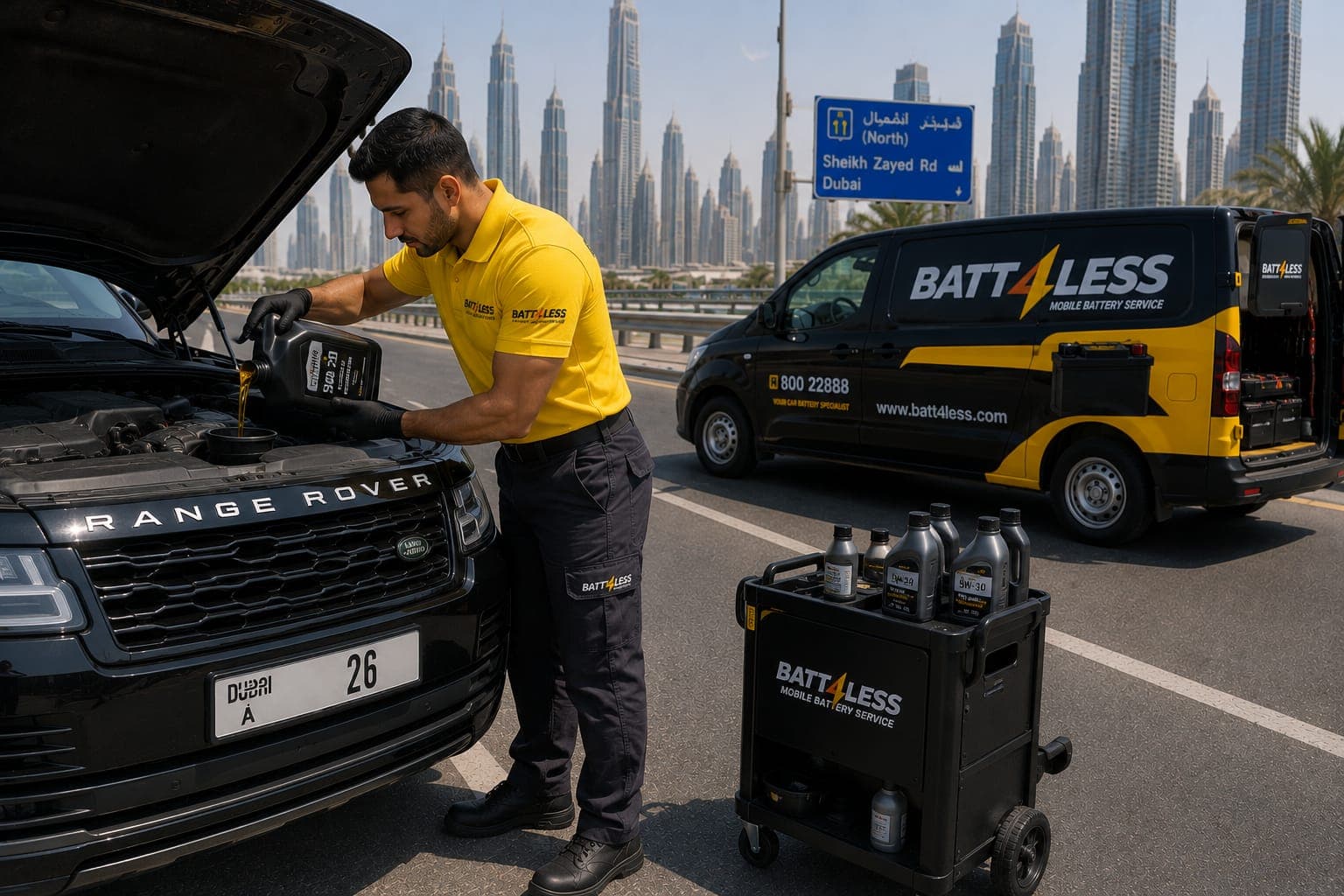
Every car comes with a manufacturer-recommended oil change interval printed in the handbook — typically 10,000 to 15,000 km, or once a year. That number is calculated in a lab, under temperate conditions, with steady highway driving. None of those three assumptions hold true for daily driving in Dubai, Sharjah or Ajman.
Extreme heat, stop-start traffic and long idling times all break down engine oil faster than the manufacturer's test conditions ever anticipated. Sticking to the printed interval in the UAE isn't cautious — it's often already too late by the time you get there.
Why the manufacturer's interval doesn't apply here
Oil change intervals are calculated assuming moderate ambient temperatures, typically 20–25°C, with mostly steady-speed driving. In Dubai, engine bay temperatures regularly exceed 100°C in summer, and the average commute involves far more idling and stop-start traffic than the test cycle assumes. The manual isn't wrong — it's just describing a climate you don't live in.
Heat breaks oil down chemically, not just physically
High temperatures accelerate oxidation, the chemical process that turns fresh oil into a thicker, sludgier fluid that lubricates poorly and traps heat instead of carrying it away. Once oil oxidizes, no amount of driving smooths it back out — it needs to be replaced, and in UAE summers that point arrives thousands of kilometres before the manual's number.
The realistic interval: every 5,000–7,500 km
Most technicians working in the UAE recommend changing conventional and semi-synthetic oil every 5,000–7,500 km or every 4–6 months, whichever comes first — roughly half the manufacturer's printed figure. Full synthetic oil holds up better under heat and can typically stretch to 8,000–10,000 km, but even that is well short of the 15,000 km some handbooks suggest.
Signs your oil is overdue, no matter the odometer
A few warning signs matter more than the mileage counter: a burnt or acrid smell from the engine bay, oil that looks black and gritty rather than amber on the dipstick, a louder or more ticking engine, or the oil change light illuminating. Any of these means the interval has already passed, regardless of what the sticker on your windshield says.
Short trips and heavy traffic quietly shorten the interval further
An engine needs to reach full operating temperature to burn off condensation and fuel residue that contaminate the oil. Short school runs and stop-start commutes rarely get there, so the oil accumulates moisture and unburned fuel faster than a highway-driven car covering the same distance. If most of your driving is short hops around the city, lean toward the lower end of the interval.
Choosing the right oil grade matters as much as the interval
A full synthetic 0W-20 or 5W-30 (check your handbook for the exact grade) copes with UAE heat far better than a mineral oil designed for temperate climates. Paying more for the right synthetic oil upfront is usually cheaper than the extra engine wear from stretching a mineral oil change too far.
Need mobile oil change service in Dubai, Sharjah & Ajman?
Our technicians are available 24/7, anywhere in Dubai, Sharjah & Ajman, with a 30-minute* average response time.